AAUP-UC Executive Council Editorial: Renewing Our Call for Clarity and Shared Governance Amid the COVID-19 Pandemic

Colleagues,

We know how incredibly hard everyone is working to prepare for an unpredictable Fall semester, coming as it does on the heels of an equally unpredictable and exhausting Summer semester, and we sincerely thank you for your efforts. In the past few weeks, we have noticed a growing number of policy documents emerging from various Colleges regarding health and safety protocols, required cleaning regimens, and other return to campus procedures and guidelines for UC Faculty, staff, and students. Some of these College level policy documents and guidelines appear to align with UC’s “Return to Campus Guide” (www.uc.edu/publichealth/return-to-campus-guide.html); however, others don’t.

To expect each College to put into place different policies, protocols, and guidelines about critical practices affecting the health and wellbeing of the entire UC campus community is not just inconsistent policymaking on the part of the University, but is also unnecessarily confusing to Faculty, students, and staff members, who are already trying to navigate a difficult, stressful, and constantly changing environment. In truth, UC Faculty, students, and staff travel daily between multiple university buildings regardless of which College those buildings ostensibly belong to.

Despite well-meaning College level efforts at clarity, many unanswered questions remain. For example:

  • What will happen if a professor decides the risk of teaching face-to-face is too high and wants to move their classes fully online after the semester has begun?
  • How will data about COVID-19 infection rates be communicated to UC faculty, staff, and students?
  • Where do students go to get a COVID-19 test? Where do faculty and staff go?
  • How will faculty be notified that students in their classes have received a “waiver” to the universal mask policy?
  • What is the procedure for proving the need to quarantine—whether student, staff, or faculty member—in the case of possible exposure to COVID-19 from outside UC?
  • How should faculty and staff interpret policies with vague or unclear language, e.g., “areas will be cleaned”? Who exactly is doing the cleaning and how is compliance with these policies being managed?
  • At what number of infections in a classroom/college/dormitory will the Administration consider closing all in-person interaction in that area?

Going forward, we hope to see UC Administration taking a more direct leadership role in shaping consistent policy on these matters. In the spirit of shared governance, the AAUP-UC is ready to work with all groups affected by these patchwork policy documents, including Faculty Senate, Staff Senate, Student Government groups at both the undergraduate and graduate levels, and the Administration, to create a “Best Practices” document and an FAQ that can address some of the more immediately pressing concerns.

In certain instances since the pandemic began, the Administration has engaged in meaningful shared governance at both the University and College levels through soliciting faculty input and, where necessary, involving faculty in decision-making. Unfortunately, in other instances the Administration is working to enact policies without shared governance; most recently in the form of two proposed mandates—flu vaccinations and a contract-tracing application—that would change working conditions for Faculty.

The June 2020 National AAUP statement, Principles of Academic Governance during the COVID-19 Pandemic, makes clear that:

The COVID-19 pandemic must not become the occasion for administrations or

governing boards to jettison normative principles of academic governance. The

Committee on College and University Governance regards such a course of action

as not only unacceptable but detrimental to both the effective operation and the

welfare of the institution. During this challenging time, the committee calls upon

administrations and governing boards, in demonstrated commitment to principles

of shared governance, to maintain transparency, engage in ‘joint effort,’ and honor

the faculty’s decision-making responsibility for academic and faculty personnel

matters as the most effective means of weathering the current crisis.

At the University of Cincinnati and other universities where faculty have formed strong unions, these shared governance rights are not just aspirational—they are effectively safeguarded by the Collective Bargaining Agreement.

However well-intentioned they are, the processes by which the Administration adopted its policy purporting to mandate flu vaccinations for everyone (see UC Provost email, “Return to Campus: What You Need to Know,” August 6, 2020), and their less publicized effort to mandate that everyone install a contact-tracing application on their personal devices do not pass muster under either principles of shared governance or requirements for collective bargaining.

According to the Ohio Legislative Service Commission, mandatory vaccinations would be a subject over which a public employer in Ohio would have to bargain with the union.1 Even with a vaccination requirement, an employer in Ohio must provide an “opt out” option for limited medical or non-medical reasons. UC’s new policy does not appear to provide that.

The AAUP-UC Chapter strongly encourages Faculty to take every step possible to maintain their own health and protect the health of everyone in the UC community. That could entail appropriate vaccinations, such as the seasonal flu vaccine, so as not to risk a weakened immune system during the pandemic. However, that is a decision best made between Faculty and their individual healthcare providers.

Similarly, UC’s effort to mandate that everyone install a contact-tracing app on their personal devices, while well-intentioned, raises significant privacy concerns (including HIPAA, the Ohio Constitution, and the Fourth Amendment of the U.S. Constitution). Once more, making installation of the application mandatory would constitute a change in working conditions that cannot be imposed without following Ohio’s laws on collective bargaining.

On both matters, it is the professional opinion of the AAUP that these policies amount to changes in the terms and conditions of Bargaining Unit Faculty Members’ employment. As such, they cannot be implemented without bargaining with the various employee unions at the University.

To be clear, the Administration can recommend that everyone protects their physical health with appropriate vaccinations and utilizes technology to help us all learn how COVID-19 spreads so that we can more effectively limit that spread. Likewise the AAUP-UC also encourages Faculty, in consultation with your health care professionals, to do the same, and stands ready to work together with the Administration to find solutions that respect the individual rights of UC Faculty as well as our collective bargaining rights under Ohio law.

As we have watched our country face the COVID-19 pandemic these past seven months, we have seen that fifty separate, state-level responses cannot make up for the lack of a unified, effective national strategy. Likewise, the entire UC community will benefit from coordination and leadership that gets everyone on the same page, rather than having a patchwork of College or academic unit level responses that are inconsistent and confusing.

As always, AAUP-UC pledges to continue working to ensure that Faculty have a strong voice in the policymaking processes that affect our working conditions and our well-being and will remain vigilant to ensure shared governance rights are protected.

In solidarity,

AAUP-UC Executive Council

1.https://www.lsc.ohio.gov/documents/reference/current/membersonlybriefs/133Ohio%20Immunization%20Laws.pdf

Budgets are choices. Budgets are value-based. Budgets reflect priorities.

In this issue: 
Budgets are choices. Budgets are value-based. Budgets reflect priorities.
Covid 19 updates

The AAUP-UC chapter leaders believe strongly that the University of Cincinnati’s budget should prioritize UC’s mission to serve the public good through teaching and research. This is why we have been promoting a Fight for 51% campaign urging university leaders to allocate the majority of UC’s budget to the core academic mission. Now, as we face the effects of the COVID-19 pandemic, this effort to refocus on academic priorities takes on even more urgency.

At the Faculty Senate meeting on 5/14/20, Bob Ambach, Senior Vice President for Finance & Administration, presented a budget plan indicating the need for a “reallocation” (cut) of $75.9 million. This was discussed as a 20% reduction out of a base of $379 million. However, some important context was missing, as noted in the following four points.

  1. The university’s total budget is much larger than what was discussed. The UC Budget Book indicates a total budget in excess of $1.36 billion. Removing $308 million in restricted funds (endowments, ear-marked gifts, etc.), this still leaves over $1 billion. The proposed cut would be between 7% and 8% of this larger base — not 20%. We do recognize that the Budget Book provides projections, not actual expenditures, and that Board of Trustees approval may be required to shift certain funds. We look forward to seeing more information on actual spending and the availability of funds.
  2. Budget proposals are still being generated under the framework of Performance-Based Budgeting (PBB). In an AAUP survey of represented faculty during AY 2018-19, we found that only 3% of faculty thought that PBB provided sufficient resources to their academic unit, and 70% agreed that “PBB has negatively affected the core academic mission.” PBB was scheduled to be phased out this coming year, but it appears to be hanging on. It is not clear why the administration continues to use a budgeting approach that failed to provide sufficient resources to academic units even before the COVID-19 crisis.
  3. A large portion of the estimated budget shortfall is based on assumptions that the university will incur a $43 million cut in support from the state of Ohio and will lose $24 million in tuition revenue due to declining enrollments. However, no decisions have been made at the state level about next fiscal year’s budget, and summer enrollments have reached an all-time high. The situation is fluid, and any budget reductions need to be contingent so that jobs are not lost, or programs irreparably harmed, based on assumptions that turned out to be incorrect. Perhaps the UC administration has developed budgets for many scenarios, but these have not yet been shared with faculty.
  4. It is not clear what plans are being made for reductions to spending on athletics and administration. The subsidy to cover the annual deficit in athletics has grown to a staggering $29 million. Siphoning that much money out of the academic side each year was not sustainable even before COVID-19. Perhaps the UC administration has plans to reform the athletic budget so it no longer drains academic resources, but these plans have not yet been shared with faculty. Similarly, we have not yet seen plans for reversing the growth in administrative positions and salaries. In our 2018-19 survey, 79% of faculty thought the university was spending too much on athletics, and 71% thought there were too many administrators. It stands to reason that faculty would have even greater concern about these misplaced spending priorities in the midst of a financial crisis.

With the above context in mind, and in a spirit of collaboration, the AAUP-UC and Faculty Senate are convening a Joint Committee to collect data and propose solutions to the financial challenges facing the university. This committee, comprised of two faculty appointed by the AAUP, two appointed by Faculty Senate, and hopefully members of the administration as well, will be charged with working expeditiously to: 1) Fully understand the implications of this crisis; 2) Propose solutions; 3) Advocate for the core educational and research mission of the university.

To be effective, this committee’s work must be completed before the June 23rd Board of Trustees meeting, as the fiscal year begins on July 1. We recognize that the financial crisis caused by COVID-19 is real, but we seek to find constructive ways forward. We would rather take this opportunity to reimagine the future in a positive way that reaffirms our core mission, than let our fear of uncertainty undermine the university we all love. One of the courageous leaders of the 20th century, Bishop Desmond Tutu, observed: “A time of crisis is not just a time of anxiety and worry. It gives a chance, an opportunity, to choose well or to choose badly.” We now have a unique opportunity to choose to recalibrate UC’s budget priorities, but this will only happen if faculty engage in the process of shared governance.

Shared governance is more than merely “being informed” of a decision. Shared governance is the work of a community to engage in dialog with facts and contexts to make the best plans for the community as a whole.

We are not powerless in this unless we choose to be. We can instead choose to participate in the conversation of shared governance, and by participating, change the shape of our priorities and our future. This is what organizing is. This is the work we can do when we all work together. We are the University.

By Steve Mockabee, PhD., and Phoebe Reeves, M.F.A


COVID-19 Questions and Answers

The Chapter continues to receive questions about possible salary freezes or salary reductions. There has been much activity and many communications, so to reiterate a few critical points:

Any change in wages or any aspect of the Collective Bargaining Agreement (CBA) would have to be negotiated by AAUP-UC and the Administration. To date neither has proposed re-opening the CBA. Further, a financial exigency has not been declared at UC and no retrenchment has been proposed.  AAUP-UC is determined to be as transparent as possible during this difficult period. We will notify the Bargaining Unit if there is any proposal that would alter the CBA or affect Faculty.

AAUP-UC and the Faculty Senate have convened a Joint Committee to collect data and propose solutions to the financial challenges facing the university. In the spirit of shared governance, the Joint Committee proposes to work with the Administration and the Council of Deans to:

      • Fully understand the implications of this crisis;
      • Propose solutions;
      • Advocate for the core educational and research mission of the university.

All of AAUP-UC’s actions, as well as the actions of the Joint Committee, are designed to preserve the core academic mission. This includes working in solidarity with adjunct faculty and the staff members that are critical to this mission.

AAUP-UC has conducted two university-wide town halls and is conducting more at the college level. If you are interested in a town hall for your college, contact your college’s Associate Council member or email the Chapter office.

Thank you to the many, many Faculty members who have joined AAUP-UC over the last two months. The Chapter is now at a high point in terms of the number of members and the percentage of membership. If you have not already done so, please join AAUP-UC today. You are receiving this communication as a member of the Bargaining Unit; however, being a member of the Bargaining Unit does not mean you are a member of AAUP-UC.

The protections provided by the AAUP-UC and the CBA have become strikingly clear in the midst of the Covid-19 crisis. It is only through robust and engaged membership by a majority of UC Faculty that the AAUP-UC will be able to succeed in limiting the financial impacts of the crisis. >Click HERE to join or email the office to determine if you are a member.

By Connie Kendall Theado, Ph.D

Solidarity in the Time of coronavirus: Stay Connected, Stay Vigilant

In this issue: 
Article 28
You Do Not Have to Be Good

 I write today with sincere appreciation for the honor of serving as the new president of AAUP-UC. I decided to run for chapter president because of my long-standing commitment to higher education and the pressing need for higher education, including UC, to re-commit to the core academic mission of the university—teaching and research. The coronavirus pandemic has changed everything, making this re-commitment to our mission all the more necessary.

As Aisha S. Ahmad writes in her March 27, 2020, advice column in The Chronicle, “Global catastrophes change the world” (para. 3). More, she suggests that “even if we contain the Covid-19 crisis within a few months, the legacy of this pandemic will live with us for years, perhaps decades to come. It will change the way we move, build, learn, and connect” (para. 3).

The number of changes already made in our personal and professional lives is undeniable. The universal move to online teaching environments, the ramping up of technology and creation of just-in-time learning supports for our students, the rearrangement of our homes and our families’ lives to accommodate the demands of working remotely—all efforts meant to protect the health and wellbeing of our UC community. Photos from around campus, the city of Cincinnati, the state, the nation, and the world at large show an unvarnished truth: life in the time of coronavirus is anything but business as usual. It is taking an enormous outpouring of energy, individually and collectively, to manage our lives in these uncertain times.

The way through such uncertainty? Stay connected—to each other and to the present moment—which is to say, stay vigilant. Rather than paper over the inevitable disruption a pandemic brings to our everyday lives, Ahmad advises, perhaps counterintuitively: “Let it distract you. Let it change how you think and how you see the world” (para. 15).

In other words, this is a time to take stock. A time to reflect on the vital role higher education plays in the health and wellbeing of our society, especially in times of national crises, and re-commit to the academic mission of the university—teaching, research—as “essential” work and its faculty, in turn, as “essential” workers. Like all universities, the long-term welfare of UC ultimately depends on attracting and retaining quality faculty and students. Weathering this crisis successfully, then, depends on prioritizing both the maintenance of a robust instructional faculty and the allocation of resources to our core academic mission.

On behalf of the Executive Council members, I’d like to thank you all for your extraordinary efforts to support your students and your programs, for your strength, your compassion and care. We applaud your good work and your good will. If we can support you in your efforts, please reach out to us.

In solidarity,

Connie Kendall Theado
AAUP-UC President

Ahmad, A. S. (2020, March 27). Why you should ignore all that coronavirus-inspired productivity and pressure. The Chronicle of Higher Education.


Article 28

The Chapter has received numerous queries asking whether faculty furloughs or wage reductions are possible in the wake of the global coronavirus crisis. For fulltime faculty—those covered by the Collective Bargaining Agreement (the CBA)—there are only two ways that this could happen.

First, the administration could bargain with the Chapter, as required by state law, over any change in working conditions, including furloughs or salary reduction. This requirement is one of the benefits of being represented by a union and protected by a CBA. To date, the administration has not proposed any changes in working conditions nor have we received a request to open negotiations.  If the current situation changes, there would be a formal  process for convening and managing such a dialogue. Similar to the collective bargaining process, Faculty and Librarians would have ample opportunity to provide feedback before the Chapter enters into any negotiation with the administration.

Secondly, the administration could invoke Article 28, Retrenchment Under Conditions of Financial Exigency. A financial  exigency is defined by Article 28 as an “imminent financial crisis which threatens the institution as a whole” that may result in the “termination of tenured Faculty or termination of untenured Faculty during the period of their appointment.” Again, there has been no notice from the administration that they plan to  invoke Article 28.

Following is a summary of the Article 28 process. In the event  Article 28 becomes a real possibility, the Chapter will send further communications outlining the process in more detail. You can also review Article 28 in the Collective Bargaining Agreement

Summary of Article 28

  • The Administration will present the anticipation of a financial exigency and the data to support it to the AAUP-UC Chapter.
  • After a period of review, the Administration and the Chapter shall submit joint or separate recommendations to the Board of Trustees on whether a condition of financial exigency exists.
  • The Board of Trustees declares at a public meeting that a financial exigency does or does not exist.
  • If a financial exigency is declared, the Chapter and the administration appoint a 14-member committee to study the issue and to investigate ways to relieve the exigency by means other than retrenchment, including programs or activites that:
    • (a) are not self-supporting (that is gifts, grants, contracts, or income from endowments designated for or other funds produced by that activity are less than the expense of that activity excluding tuition remission), or
    • (b) are not in direct support of academic programs, or
    • (c) are not essential for continued operation of the academic program of the University.
  • If Faculty terminations are recommended, the affected Faculty will be notified and will have the opportunity for comment.
  • The Committee shall present its recommendation or recommendations to the Board of Trustees in writing. Any recommendation with the support of five members will be transmitted to the Board.
  • At a public meeting, the Board can adopt the recommendation or recommendations from the Committee to relieve the financial exigency or send it back to the Committee to provide an alternative plan. If a recommendation is not sufficient to relieve the exigency, the Board can act on its own initiative.
  • If an appointment is terminated, the Faculty Member shall receive salary or notice in accordance with the schedule provided in 28.9 of the CBA.
  • Note that Article 28 only covers fulltime Faculty and Librarians (i.e., members of the bargaining unit). Unrepresented and adjunct faculty (at less that 65%) are not protected. Their condition will  necessarily be considered as the Chapter works with the Administration in the spirit of shared governance to solve this critical issue.

No doubt by now you’ve all read one too many think pieces about teaching in the Corona Virus Crisis. You’ve heard hot takes by professors, students, administrators, and politicians. You’ve seen funny Tik Tok parodies of the different “types” of on line teacher and laughed over a WebEx faculty meeting bingo card, maybe. Perhaps you don’t need another reminder about what this situation looks like, but what I’m offering you are the words I myself need to hear.


You Do Not Have to Be Good

First, it’s okay not to be okay. It’s okay to be tired, anxious, sleepless, and short on patience. It’s okay to feel a little claustrophobic, to be eating too much or too little, to be watching too much TV or find yourself unable to read a favorite book. I’d say it’s normal, but what’s normal?

Second, it’s okay not to want to “take advantage” of the many “virtual professional development” opportunities that are piling up in your in-box. It’s okay to set aside a research project for a while, to not find an on-line conference to replace the conference you didn’t go to in March. You’re allowed to slow down and spend your energy elsewhere, and you’re allowed not to have any energy. Your value as a human being is not defined by your current productivity or lack thereof.

Finally, it’s okay if your classes aren’t the best pedagogical exemplar, whether they began as online classes or are face to face classes suddenly forced by exigency into a remote format. In fact, as others before me have argued, it may not even be appropriate to aim for perfection or excellence right now.  This is not about a “newbies vs experienced on line teachers” comparison. No one should feel they have to aim for excellence in this “remote classroom” crisis, regardless of the training or background they have in on line instruction under normal circumstances.

Our students don’t need one more Power Point with embedded lecture that took you ten hours and a sleepless night to construct. Some of them don’t have the internet to even watch it. Our students don’t need extra discussion boards or group projects.  Some of them are working double shifts at the hospital or the grocery store. Some of them are home with children, home with difficult family members, or home with violent partners. Some of them are suddenly unemployed.

What they need may be far beyond the scope of what we are equipped to provide. They may be disappearing, not turning in work, not showing up to synchronous classes or office hours, and the reasons for their changed behaviors are probably wildly varied. Similarly, some of your course material may not ever translate appropriately to an on line format—and that is through no fault of your own. Music lessons, studio classes, and labs, among other things, won’t just magically migrate to digital versions of themselves. It’s okay to mourn the loss of those opportunities.

What I’m trying to aim for in my new, “remote” versions of classes that were face to face is a clear focus on the course outcomes. A triage of what feels most essential, with lots of reminders and additional support. Even so, many of my formerly high-performing students are MIA or suddenly turning in all their work late and half-finished. More than anything, I’m reminding myself not to take it personally. Most of them have bigger problems than our annotated bibliography.

Some in higher education will take advantage of this sudden shift in instruction to tout what they see as the benefits of on line classes, or to try to put a positive spin on the situation—“Look at all the shiny new tech you can use now” and so on. I’ll be sitting over here being the curmudgeon who argues that what we and our students need most now is the least technological thing possible—a little empathy and a lot of forgiveness.


Wild Geese

You do not have to be good.
You do not have to walk on your knees
For a hundred miles through the desert, repenting.
You only have to let the soft animal of your body
love what it loves.
Tell me about your despair, yours, and I will tell you mine.
Meanwhile the world goes on.
Meanwhile the sun and the clear pebbles of the rain
are moving across the landscapes,
over the prairies and the deep trees,
the mountains and the rivers.
Meanwhile the wild geese, high in the clean blue air,
are heading home again.
Whoever you are, no matter how lonely,
the world offers itself to your imagination,
calls to you like the wild geese, harsh and exciting —
over and over announcing your place
in the family of things.

by Mary Oliver

Hear the poet read the poem here: https://youtu.be/lv_4xmh_WtE

Phoebe Reeves, M.F.A.
AAUP-UC Vice President

UC Administrators Out Number Faculty

In this issue:
UC Administrators Out Number Faculty
Durable Medical Equipment
FacultyFaculty Spotlight


UC Administrators Out Number Faculty


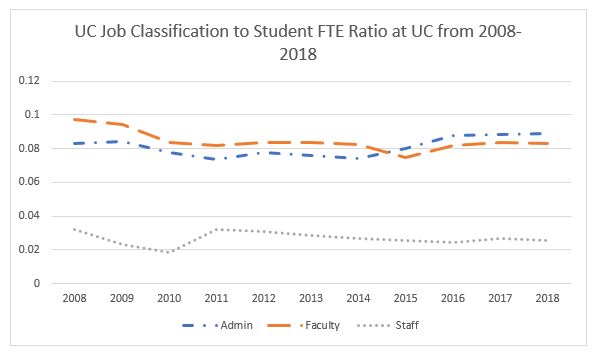
In past issues of The Works, the AAUP has tracked how the ratio of full-time faculty to student full time equivalencies (FTE) has fallen over the past decade despite record breaking enrollments and a 25% increase in student FTES. New research indicates that not only have the ratio of faculty* FTEs to student FTE’s decreased, but the ratio of staff** FTEs to student FTEs has fallen as well. The ratio of administrator*** FTEs to student FTEs, however, has risen during this same time frame. In 2008, the total number of staff FTEs was 970, but by 2018, that number fell to 967. In other words, UC had approximately 1 staff FTE per 31 student FTEs in 2008, but by 2018, UC had 1 staff FTE per 38 student FTEs. Although the total number of faculty FTEs rose during this decade from 2918 faculty FTEs to 3140 FTEs, the faculty FTE to student FTE ratio increased from 1 faculty FTE to 10.3 student FTES in 2008 to 1 faculty FTEs to 11.7 student FTES in 2018. UC saw a significant increase in the total number of administrators, which rose from 2505 FTEs in 2008 to 3361 FTEs in 2018. In 2008, UC had 1 administrator FTE for roughly 12 student FTEs, but the increase in 856 administrator FTE’s by 2018 dropped the ratio to 1 administrator FTE for roughly 11 student FTES. As you can see from the graph below, the ratio of administrators to students surpassed faculty to student ratios between 2014 and 2015.  

If having more administrators to students than faculty to students wasn’t troubling enough, these numbers only tell part of the story. This data comes from the Integrated Post-Secondary Education Data System (IPEDS)****, which doesn’t distinguish between full-time and part-time faculty. In past issues of The Works, the AAUP has discussed the decreasing number of full time faculty members as well as the decrease in tenure track lines, but this data suggests that even with increasing reliance on contingent faculty we are falling behind in our faculty to student ratios.  

In the 51% campaign, the AAUP has argued that 51% of college revenue should stay in the college and be controlled by the college, but currently, colleges only retain approximately 43% of their revenue. An additional 3% cut to college budgets has been announced for the upcoming fiscal year 2021. The increase of 856 administrator FTEs points to a potential explanation for where a portion of the colleges’ revenue has been diverted. Further research comparing the total salary dollars of each of these categories would help illuminate what the impact of these administrator FTEs have had on UC’s budget. 

*For the purpose of this research, faculty are defined using the Higher Learning Commissions definition. HLC’s definition of faculty includes “employees whose primary responsibilities are instruction, research and/or public service.” This definition includes full and part time faculty including graduate assistants. 

** For the purpose of this research, staff are defined using the Higher Learning Commissions definition. HLC’s definition of staff “includes the following IPEDs categories: Service Occupations; Sales and Related Occupations; Office and Administrative Support Occupations; Natural Resources, Constructions and Maintenance Occupations; Production, Transportation and Material Moving Operations.” Full and part-time employees are included in this definition. 

*** For the purpose of this research, administrators are defined using the Higher Learning Commissions definition. HLC’s definition of administration “includes the following IPEDs categories: Management Operations; Business and Financial Operation Occupations; Librarians, Computer, Engineering and Science Occupations; Community, Social Service, Legal, Arts, Design, Entertainment, Sports and Media Occupations, Healthcare Practitioners and Technical Occupations; Archivists, Curators, Museum Technicians; Library Technicians; Student and Academic Affairs and other Educational Services Occupations.” Full and part-time employees are included in this definition. 

****IPEDS is run by National Center for Educational Statistics, which is part of the Institute for Educational Sciences. The Institute for Educational Sciences serves as the non-partisan evaluation division of the U.S. Department of Education.  

***** Acknowledgement – In the fall, the Ohio University AAUP (OU-AAUP) chapter released the “Ohio University Budget Crisis: Analysis and Proposals” white paper, which inspired this research.  


Durable Medical Equipment


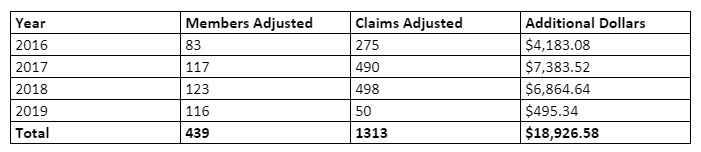
During a caucus for bargaining last spring, the bargaining team realized that in some cases the Anthem PPO plan was covering in network Durable Medical Equipment (DME)* at 80% instead of 90% as required by the Collective Bargaining Agreement (CBA). The AAUP filed a formal grievance on behalf of all bargaining unit members in June. Human Resources directed Anthem to correct the rate and re-run the Explanation of Benefits (EOB’s) for DME’s in 2016-2019. In total, the incorrect coverage impacted 439 bargaining unit members** or their dependents and included 1313 claims. The adjusted claims amounted to $18,926.58 that was due to the bargaining unit members, and the majority of the claims were for CPAPs. All affected bargaining unit members should have received updated EOB’s if they had DME’s billed at 80%. The corrected EOB’s were completed by August 9, 2019.  Refunds for overpayment, however, are to be paid to the patient by the provider. If you have not received reimbursement, please contact your provider.  


 This grievance highlights an advantage of being represented by a union. Without the AAUP, each of the 439 members of the bargaining unit would have to 1) realize that they were over billed and 2) work on their own to correct the issue with Anthem (likely a time-consuming process). The grievance process allowed the AAUP to file a class action grievance and members, some of whom may have had no idea that an error in billing had occurred, are now entitled to a refund. WE ARE STRONGER WORKING TOGETHER! *The 2019 Anthem Medical Benefit Booklet defines DME’s as “Equipment which is (a) made to withstand prolonged use; (b) made for and mainly used in the treatment of a disease of Injury; (c) suited for use while not confined as an Inpatient at a Hospital; (d) not normally of use to persons who do not have a disease or Injury; (e) not for exercise or training.” Examples of DME’s include CPAP machines, insulin pumps, wheelchairs, custom made knee braces, etc. **The total affected bargaining unit members may not be unique. Some members could have been impacted in more than one year. 


Questions and Answers with:Robert Gioielli Associate Professor of History, UCBA Director, UCBA Honors

1.  What do you do here at UC and what’s one thing you really love about it?

I love that UC is a so grounded and connected to our local community. Although we can always do a better job with connections and engagement, having the majority of our students be from the Cincinnati area means that our teaching, training and research has a direct impact on the future of our community. I also love the fact we are an urban institution, embedded right in the city, with all of the challenges and opportunities that provides.

2. What’s something about your work you wish people knew more about?

Much of my work, both research but also teaching, has been about diversifying who gets to speak about environmental issues, and whose environmental issues we pay attention to. Traditionally the environment was primarily considered to be a priority among people like myself: white, well-educated, middle-class. But environmental issues affect us all, and often marginalized communities feel the brunt of it, as Hurricane Katrina, the Flint Water Crisis, and rapid climate change are showing us now. My research has been focused on show the deep and complex history of activism by people of color, as well as the ways that racism shapes sustainability issues within our cities. I also have worked to diversify our environmental studies curriculum, developing a new course, “Race and Environment in American History,” that will be taught at UC Blue Ash in Spring 2020, and on a regular basis thereafter.

3. What are your hopes for your students in the future?

I hope that we as faculty can work with our students to demand a more holistic and robust education for all. Unfortunately I see us going back to a nineteenth-century model, where humanistic studies, and education for the development of people and communities, for the development of good citizens, is solely reserved for an elite. In the 1800s it was wealthy, white men; today its students who have the resources and connections to attend prestigious private colleges. We are going rapidly going down the road of telling students that public universities are primarily for vocational training. That is a dangerous and self-destructive path, not only for our students, but also society. We need to collectively demand that every American, not just the wealthy and the lucky, deserve a holistic, well-rounded education.

What profession other than your own would you like to attempt?

I was a reporter at a small town newspaper for three years before getting my PhD. I still miss daily newspaper journalism, even though I know the business is not what it was twenty years ago.

What is your motto?

“Life is either a daring adventure, or nothing at all.” Helen Keller

Faculty Rights – Distance Learning and Copyright

Inside this issue:

Faculty Rights – Distance Learning and Copyright

The Chapter has received numerous inquiries regarding distance learning and how it affects Faculty here at UC.  The UC AAUP Executive Council decided it would be prudent to provide faculty with a synopsis of a few critical issues surrounding Distance Learning and our position to them.

First, the Chapter views changes of this nature, such as length of term, as curriculum and workload issues—both of which entail significant faculty governance rights before any changes could be implemented.  As with all other curricular matters, the faculty should have primary responsibility for determining the policies and practices of the institution regarding distance education. The rules governing distance education and its technologies should be approved by vote of the faculty within a unit, officially adopted, and published and distributed to all concerned.

Further changes made to your workload must be negotiated and faculty have the right to decline proposed changes.  If a faculty member agrees to provide the class online, they will require adequate time to prepare such materials and to become sufficiently familiar with the technologies of instruction prior to delivery of the course. Depending on the teacher’s training or experience, significant release time from teaching during an academic term prior to the offering of the new course will normally be required.

A faculty member engaged in distance education is entitled to academic freedom as a teacher, researcher, and citizen in full accordance with the provisions of the 1940 Statement of Principles on Academic Freedom and Tenure, jointly developed by the Association of American Colleges (now the Association of American Colleges and Universities) and the American Association of University Professors and endorsed by more than 200 educational and professional organizations.

The other significant issue pertains to copyright law and how it applies to faculty here at UC.  The Chapter’s position is that the majority of traditional faculty work belongs to the faculty and doesn’t fit as work-for-hire.  Traditional faculty work includes course descriptions, syllabi, lecture notes and other materials generated for use by students, on-line courses, tests, computer programs, grant proposals, and university governance materials.

Copyright ownership is an academic freedom issue in many cases. Scholarly work is not work-for-hire because “the faculty member rather than the institution determines the subject matter, the intellectual approach and direction, and the conclusions.” AAUP Policy Documents & Reports (11th ed. 2015). “Were the institution to own the copyright in such works, under a work-made-for-hire theory, it would have the power, [to control it] and indeed to censor and forbid dissemination of the work altogether. Such powers, so deeply inconsistent with fundamental principles of academic freedom, cannot rest with the institution.” Id.

This standard protects both the institution as well as the faculty member: the institution has no control over the copyrighted works of a faculty member and therefore is not responsible for their ideas.

Professors have the unusual responsibility, as part of their employment, to be creative and independent outside of class in their intellectual scholarly life. Thus, the position of a professor requires an “employee” who researches and writes not to promote a particular viewpoint of the employer, but one who engages in an independent search for truth and knowledge. This model does not fit into the work-for-hire framework.

AAUP policy holds that for faculty work to be work-for-hire, it requires use of extraordinary resources; use of traditional resources “such as office space, supplies, library facilities, ordinary access to computer and networks, and money,” are not sufficient to make faculty work into work-for-hire.  See, AAUP Policy Documents & Reports (11th ed. 2015).

The Chapter looks forward to working with the Administration to negotiate formal policies on distance learning and copyright to clearly delineate the rights and responsibilities for faculty as we move to providing more online classes,

UC AAUP Executive Council

Ronald Jones, President
Connie Kendall Theado, Vice President
Phoebe Reeves, Secretary
Steve Mockabee, Treasurer
Heather Maloney, At-Large Member
Sarai Hedges, At-Large Member
Cassie Fetters, At-Large Member
Chris Campagna, Associates Council Chair
Sean Hafer, Associates Council Vice Chair
John McNay, Chair, Political Action Committee
Amber Peplow, Chair, Budget & Compensation Advisory Committee
Emily Houh, Chair, Contract Compliance and Education
Alli Hammond, Chapter Representative, Ohio Conference AAUP

What Is the Meaning of Article 24.1?

Since implementation of the new 2019 – 2022 Collective Bargaining Agreement between the University and the AAUP, several questions and concerns have been raised about modified language in Section 24.1 of Article 24 – Faculty Professional Development.  In previous CBAs, in Section 24.1, “the AAUP and the University encourage(d) Faculty participation in (development) activities….”, with some development activities listed in general terms.  The University proposed changing “encourage” to “require”, but that was rejected by the AAUP.  Instead, the AAUP proposed using the word “expected”, and separating activities to align with specific responsibilities in Teaching, Scholarship and Service.  The AAUP’s suggestions for Section 24.1 were subsequently included in the final version of Article 24.

The first thing to note is that Article 24.1 is titled: “The Role of the University in Professional Development of Faculty.”  Article 24.1 does not impose any new or specific obligations on the work of Faculty Members.  Faculty Members have always been expected to participate in developmental activities during the span of their careers in order to keep current and to improve their skills.  Their specific work obligations are detailed in their letters of appointment and in the Workload and RPT documents of their respective academic units, not in the Collective Bargaining Agreement.  Rather, the intent of Section 24.1 is to relate the support given by the University for Faculty Professional Development to the varied roles of specific Faculty Members.

Different Faculty Members have different degrees of responsibility in Teaching, Scholarship and Service.  Teaching and Scholarship typically account for the bulk of a Faculty Member’s responsibilities, but in varying proportions.  Only a few Faculty Members have service as a primary responsibility.  Article 24.1 provides guidelines for “expectations”, not requirements.  A Faculty Member whose primary responsibility is Teaching would be expected to pursue development activities related to teaching, and the University would generally be expected to support that type of development activity, with development funds if needed.  For someone whose primary responsibility is Research, the general expectation would be for them to pursue development activities in research and for the University to support those pursuits, with development funds if needed.  Since many Faculty Members have significant responsibilities in both Teaching and Scholarship, it would be reasonable for there to be some proportionate developmental activities, and University support, in both categories over a career.

The modified language in Article 24.1 clarifies the relationship between the role of the Administration in support of Faculty Development and the already established expectations of Faculty professionalism.  It should not be interpreted as establishing any new requirements for Faculty Members, nor any new timelines for accomplishing professional expectations.

Dave Rubin, 2019 AAUP Chief Negotiator

Faculty Spotlight

Stefan Fiol, Associate Professor of Ethnomusicology, CCM
https://ccm.uc.edu/about/directory.html?eid=fiolsn&thecomp=uceprof_0

What do you do here at UC and what’s one thing you really love about it?

I am an ethnomusicologist, which is a fancy way of saying that I study music as an essential aspect of being human and being in connection with others. I really love that my field is an inter-discipline, one that allows me to continually learn and understand music in relation to almost limitless perspectives. This year one of my classes will be doing ethnographic projects with MYCincinnati, a community non-profit youth orchestra program in Price Hill, while another class is doing collaborative songwriting with people with dementia in partnership with UC’s Memory Disorders Center at the Gardner Neuroscience Institute.

What’s something about your work you wish people knew more about?

I wish people understood that ethnomusicology is not simply the study of ‘Other’ musics from other places, but a general approach to studying any music in relationship to those who make, listen to, and experience it.  My scholarship is concentrated in the Indian Himalayas, which may sound exotic, but I try to make this music feel familiar because it is connected to the social structures, geographical conditions, and human emotions that shape all other musical systems in the world.

What are your hopes for your students in the future?

My hope for my students is that they do not settle for existing categories and ways of thinking, but use their skills and desires to imagine new research and career pathways for themselves.

What profession other than your own would you like to attempt?

I would attempt to be a jazz pianist.  I’m glad the question included the word “attempt.”

What music’s on your playlist right now?

Celine Dion, Narvel Felts, Yonder Mountain String Band, Thelonius Monk, Vijay Iyer, Vilayat Khan (mostly because I’m teaching about these artists in the coming week!)

Who is a real-world hero to you?

The Dalai Lama